In my first installment of this story, I told you how after the Edinburgh Festival Fringe, I quietly stopped performing. It wasn’t a conscious choice, but it was an appropriate one.
I had spent a month – what felt like – begging people to come to my show. On the bus, in queues for other shows, on the street, in parks, everywhere. Given how incredibly personal the performance was, it made sense that I needed a break from the sheer exposure of it.
Back in Los Angeles, I was still being creative. Just on the down low:
- Sharing my best wisdom with Erin (intuition!)
- Painting a picture of my life for Jill (storytelling!)
- Mock street fighting with Brett (improv!)
I half-heartedly put out feelers to put on the show again. But I wasn’t excited about it.
Seemingly Unrelated
One morning in November, I wake up with a word in my mind. Busking. Do you know it? It’s when a person performs in public and welcomes tips. The most common version of busking would be a musician on the street with an open guitar case and dollar bills inside.
The idea of busking seems to be my unconscious mind’s answer to a riddle in my waking life: What work can I do that’s fun and community-oriented while also honoring my need for freedom?
It would be helpful for you to know that I live in a seaside town that tourists love. And I’m walking distance to an iconic, whimsical destination:
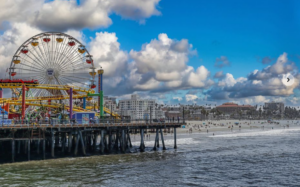
The remarkable Santa Monica Pier.
I’ve visited the pier with my cuddle community to offer free hugs many times.
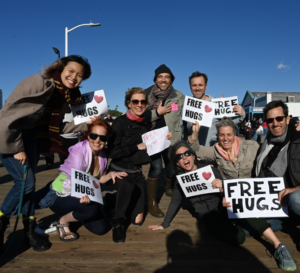
So I have a positive relationship with the Santa Monica Pier. There are people who busk there that can draw a caricature of your face or paint your name as a souvenir. What might I do?
In Search of A Service
I think about my past jobs and skills and come upon an obvious answer: face painting for children. In my twenties, I was employed by Creative Kids where I managed birthday parties. Job duties included watching little ones in the gym, serving birthday cake, and sometimes – face painting. I can’t say I was great at it, but my skills were serviceable.
What can make my face painting persona irresistible? I think about the brightly colored onesie that I’ve worn for several Halloweens. I imagine that it can make a very comfortable character outfit. Surely parents would provide a tip if a friendly costumed woman could make their tyke look like a princess or a tiger.
This is a full proof plan, I decide. My next step is to contact the city. Busking at the pier is carefully regulated and the city needs to permit me to face-paint with an actual, well, permit. The response I get on the phone is the only one I didn’t expect: Face painting on the pier is illegal.
How can that be?!
The “no face-painting” rule has been on the books for many years due to a terrible situation where a henna artist used shoe polish on people’s skin and made them sick. My first impulse, upon hearing this limitation, is to fight it. “I’m gonna go to city council meetings and make some noise!” But then I remember, “Yeah, but, I don’t really love face painting anyway.”
AI Gets Involved
I feel deflated. The next morning, I ask ChatGPT for alternative ideas. What else can a grown woman in a whimsical outfit do on the pier for tips? Among several options, it suggests I can hold up a sign that says, “Photo with Magical Unicorn.”
I love it! I could call myself Jean the Magical Unicorn!
I consider different color schemes for my sign:
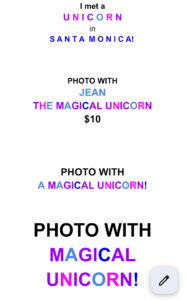
I imagine myself standing there looking so adorable, holding up one of these signs. A line of eager people and families cue up to smile with me and give me tips. It’s perfect.